Cane's House
The ExceptionCane's House is a two-story residence in a gated community, first seen by Jada Stanley as the fitting home of a man whose private life is difficult to read. It becomes more than a domestic backdrop: Jada visits it while recovering from Simon Powers's attack, shares an intimate night there with Cane Alexander, and later returns with a key only to be struck and abducted inside. The house's central significance lies in that reversal, as familiar markers of welcome and security become part of the setting for a breach of both.
Setting and Exterior
Jada and Kari approach on a blisteringly hot Saturday afternoon, sitting in Kari's car with the air conditioner running. The house before them is brown and ivory, two stories high, with a fence enclosing the backyard. Its landscaping is clean and tidy; a sprinkler is operating as Jada looks at the property. She sees it as just the sort of place Cane would live, an impression formed from its ordered appearance rather than from any explanation of his tastes.
The house stands in a gated subdivision where the other homes appear relatively new and much alike. Its backyard backs onto a golf course winding through the development. Jada wonders whether Cane plays golf, but notes that he has never mentioned it and that his impatience might not suit the game. The thought gives the setting a quietly observant quality: she is already trying to imagine how the orderly exterior fits the man she knows, while recognizing that much of his life remains unspoken.
Interior and Domestic Life
Max Quinn welcomes Jada and Kari through the doorway, kisses Kari, and tells them Cane is out back. Inside, Jada sees a bright, airy great room furnished with a black leather sofa and loveseat facing a large flat-screen television. A pool table stands behind the sofa, and magazines lie on the coffee table. The room has few personal touches; its furnishings and organization strike Jada as masculine. The impression is specific but limited: the house presents a composed domestic environment without offering many visible signs of its owner's history.
From the kitchen, Jada can see Cane tending the grill outside. The arrangement connects the interior gathering space with the backyard and makes the house a setting for informal company rather than merely a place to observe from outside. Jada's attention also turns sharply to Cane himself: in white swim trunks with a blue checkered print and sunglasses, he appears to her strikingly attractive. That response makes the house part of the developing intimacy between them, a place where seeing Cane in an everyday setting deepens her personal interest.
Recovery and Intimacy
The visit takes place after the Simon ordeal. Jada has lost some weight, and the black bathing-suit cover-up she wears hangs more loosely than before. Her nerves are beginning to settle; she is looking over her shoulder less, and her bruises have faded. She describes each day as distance from the chaos. Against that recovery, the house offers a temporary scene of ordinary social life: she arrives with her sister, finds Max there, and sees Cane at the grill.
Later that evening, Jada lies beneath Cane's blankets, content after a day she regards as fun and relaxing. She draws a black comforter up to her chin and settles into the soft sheets, briefly drifting off before the bedroom door opens. Cane comes in and offers her a bottle of water. In the bed, their closeness is expressed through practical care as well as attraction: he checks on her hydration, draws the blankets over them, and encourages her to sleep. The domestic quiet gives their relationship a different register from the danger surrounding Simon and from the conflicts tied to Cane's business.
Another exchange in bed begins when Cane nudges Jada awake and says he has a craving. The evidence places this moment in the same intimate domestic setting, though it does not establish a larger change in the house itself. The bedroom is where their private ease can unfold without an audience, and where care, desire, and shared rest occupy the same space.
Entry, Attack, and Rescue
The house's meaning changes when Jada uses a key Cane gave her the previous night. She inserts it into the lock and enters a dark room, moving instinctively toward the alarm panel. The alarm does not sound. Its blue-lit display is steady rather than flashing or demanding that she enter Cane's code, 7282. Details that previously imply access and protection instead register as warning signs: the key admits her, but the quiet alarm panel gives no explanation for the danger inside.
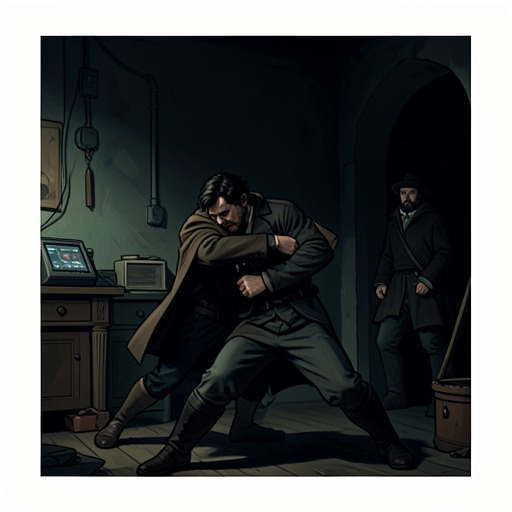
Jada tries to flee, but before she can get more than two steps, an attacker strikes the side of her head with enough force to make her lose control of her body. The house has become the scene of a sudden assault rather than a secure refuge. Later, Cane arrives at his house on Sheffield Road and parks beside Jada. He notices that no lights are on and wonders why she has not turned one on. The dark exterior becomes the first indication that something is wrong, connecting the house's appearance to his discovery and response.
Jada regains consciousness restrained in Cane's office, her mouth covered by a bandana and her eyes swollen and hazy. The office is lit only by the glow of Cane's computer screen and the security lamp outside. This interior space is distinct from the bedroom and great room, but it is part of the house's domestic footprint; its familiar association with Cane sharpens the terror of finding herself captive there. When officers enter in formation with guns drawn, Jada is still struggling with the restraints. The arriving police call for ambulances, drug teams, and K9 units as the room is illuminated and the scene becomes visible. The house thus becomes a site of formal intervention after the attack, not simply a private space in which Cane or Jada can act alone.
Narrative Significance
Cane's House gathers sharply opposed experiences without changing its basic physical identity. Its tidy landscaping, gated setting, airy common room, and soft bed make it legible first as a comfortable home and a place where Jada can rest while recovering. The key, alarm panel, darkened rooms, and restrained captive expose the limits of those outward signs of safety. The contrast gives ordinary domestic objects narrative weight: the key represents access, the alarm's silence fails to protect, and the absence of lights alerts Cane to an unexplained disturbance.
The house also marks a shift in the scale of the conflict. Jada's relationship with Cane has a private, domestic dimension there, but the attack turns that privacy into vulnerability; the eventual arrival of police brings the danger into view and introduces an institutional response. The same residence that accommodates a shared meal, a bottle of water, and sleep becomes the setting for violence and rescue. Its importance rests not on an elaborate description of its architecture, but on how those familiar rooms are made to hold comfort, trust, violation, and intervention in succession.